


The Spanish Untouchables
-
[image: Busto del Rey Juan Carlos I de España en su vi...]
A new tell-all book that details what led to Spanish king Juan Carlos
giving up the throne wou...
gang of four drug dealers have been jailed for conspiring to supply illegal drugs across Kent. Brothers Joseph and Samuel King, Craig Provan and Matthew Newin controlled dealing in towns across Kent from a travellers' site in West Malling. Joseph King, 48, was jailed for 18 years and Samuel King, 47, for seven-and-a-half years at Canterbury Crown Court. Provan, 41, was sentenced to six years, and Newin, 26, to eight years. Joseph King, of Lavender Road, West Malling, and Provan, of The Paddock, Highsted Valley, Rodmersham, were found guilty of conspiracy to supply drugs. King was also convicted of possessing firearms with intent and for possession of criminal property. His brother, of Elm Grove, Sittingbourne, and Newin, of Swanstree Avenue, Sittingbourne, pleaded guilty to conspiracy to supply drugs. Undercover operation During the seven-week trial, the jury had to be given basic lessons in a 16th Century Romany dialect called Rokker, which was used by two of the gang. They were caught after the travellers' site next to Hoath Woods was infiltrated by undercover police officers. Thousands of pounds worth of heroin, cocaine and ecstasy were exchanged during more than a dozen transactions between June and September last year. The court heard the gang controlled street dealing in a number of towns across Kent and had a particular hold in the Canterbury and Sittingbourne areas.
0
comments
HEALTH experts are calling for more full-time drug and alcohol support services in the the north-west to reduce alarming rates of heroin overdose. The most-recent Ambulance Victoria statistics show Brimbank had the third-highest rate of heroin overdoses attended by paramedics in Victoria. In 2009-10, there were 111 overdoses during the year, compared to 87 in 2008-09. Heroin overdose attendances by paramedics were also up in Melton Shire, with 23 in 2009-10 compared to 10 in 2008-09. The Stepping Up consortium, which runs the only drug and alcohol support service in Melton, has seen about 200 people from the area since opening in January. General manager Shelley Cross said she was initially worried the four-year pilot project wouldn't reach client targets set by the Department of Health. But the service has already surpassed that target. She said the demand for additional services was strong in high-growth areas like Melton. Team leader Raymond Beacham said there was a need for more full-time services. "We're starting to see more clients come in from Caroline Springs and most of our clients use more than one substance," he said. "Melton never really had full-time drug and alcohol services until we came in and it would make it a lot easier for people to access support if there were more full-time services around." Mr Beacham said services provided education to drug users so they were more aware of what they were injecting. "Most overdoses are accidental and they often occur because drug users don't know the strength of what they are using or they're mixing substances. "People who overdose from drugs are at risk of developing brain damage and can die from it." Family members of overdose victims reflected on their loss on Overdose Awareness Day on August 31. Drug and alcohol support service providers, like Health Works in Footscray, held ceremonies to remember people who died of an overdose, as well as those who live with permanent injuries. Head of clinical services at Turning Point Alcohol and Drug Centre in Fitzroy, Dr Matthew Frei, said substance addictions could be associated with conditions like depression and required medical treatment. "There is a certain stigma attached to drug users and people who die from overdose, but we need to encourage drug users to seek treatment to reduce harm to the individual and the community," Dr Frei said.
WOMAN pal of a man jailed over a €440m drugs seizure has been caught smuggling €6,000 of heroin into his prison. The middle-aged woman was caught by prison officers last week when she arrived at the Midlands Prison for a visit to Joe Daly (44). He is serving a 25-year sentence after being convicted of possessing the biggest cocaine haul in the State's history -- a seizure of 1.5 tonnes of cocaine at Dunlough Bay in 2007. Prison staff contacted gardai, who then arrested the woman. She was brought to Portlaoise Garda Station where she was questioned by detectives before being released without charge. A file is now being prepared for the DPP. Captured Sources say if the heroin had got into the jail, it would have had a value of "well over four times" the estimated street value that gardai put on the drug. The woman was not allowed to visit English national Daly after being caught with the drugs. Daly and three other English criminals are serving lengthy jail terms for their role in the plot to smuggle €440m worth of cocaine into Ireland in July 2007. Martin Wanden (48), police- killer Perry Wharrie (51), Gerard Hagan (27) and Daly were captured after diesel, instead of petrol, was put into the fuel tanks of their boat, which was carrying the drugs off the coast of Co Cork. When the vessel capsized, 62 bales of cocaine weighing over 1.5 tonnes were thrown into stormy seas, scuppering a huge drugs operation that had been months in the planning. Liverpool criminal Hagan admitted his role in the enterprise and was jailed for 10 years. However the other three men contested the charges but were convicted after a marathon 10-week trial at Cork Circuit Criminal Court which heard from 200 witnesses. Two of the defendants claimed in direct evidence that they were entirely the victims of circumstances, coincidence and bad luck. Joe Daly said he had only gone to west Cork as a favour for his brother, who had wanted a RIB delivered. But it would later emerge that Joe Daly's brother was Michael Daly (50) -- a former Metropolitan Police detective who is now serving combined sentences totalling 29 years in a UK prison in relation to the Co Cork plot and another cocaine importation plot. Gardai believe that Joe Daly became involved in the drugs smuggling operation through his older brother, Michael. Daly presented a defence that depicted him as very much under the influence of the brother. Children Born in London to Irish parents from west Cork, Daly worked as a bricklayer with his own business, JD Bricklaying, is married with three children and lived in Bexley, Kent. It emerged that he had a number of previous convictions in the UK for offences including threatening and abusive behaviour, assaults on police officers and possessing a blade. During the trial, his uncle, Tom Lydon, told how Daly visited him on the day before the drugs seizure and watched the Munster football final between Cork and Kerry on TV. He described him as very obliging -- "the first man to come around" if anyone needed help.
One by one, motorists arrived, rolling down windows and giving up cash, as they would at a fast-food restaurant. This drive-through opened at 11 a.m. some days, but lunch was never on the menu. Instead, customers could order cocaine, oxycodone, ecstasy and marijuana. Guns, too. At a news conference Wednesday, the Hillsborough County Sheriff's Office announced that it had broken up a drug trafficking ring that caught even investigators by surprise. About 11 months ago, deputies began building cases against two men reputed to be dealing drugs in a neighborhood near University Mall. Investigators thought Zavien Brand, 28, and Joseph Nurse, 35, might lead them to a few more people, maybe six or eight, said sheriff's Maj. J.R. Burton. But the small undercover probe soon turned into a larger investigation — dubbed Operation Pandora's Box — as deputies realized the area's loose-knit group of dealers included dozens of people. On Wednesday, sheriff's officials announced they had 54 warrants and, as of 4 p.m., 32 arrests, most on drug and gun possession charges. "We had no idea this was going on," Burton said. They focused on several addresses in the neighborhood near Nebraska and Fletcher avenues. The drive-through was at the Pines I Apartments at 11720 N 14th St., deputies said. Deputies took 29 guns off the street, including seven assault rifles and two weapons believed to be linked to shootings in the area. Also seized: about 1.3 pounds of crack cocaine, 0.64 ounces of powder cocaine, 0.25 ounces of oxycodone and some ecstasy — valued at about $75,000 total, Burton said. Burton hopes the operation sends a message to an area that has long struggled with crime, and he wants residents to know that deputies aren't done. Brand was charged with dealing crack cocaine and being a felon in possession of a gun. Nurse was charged with dealing crack cocaine, marijuana and stolen property. Deputies planned to continue executing search warrants until they arrest all 54 suspects.
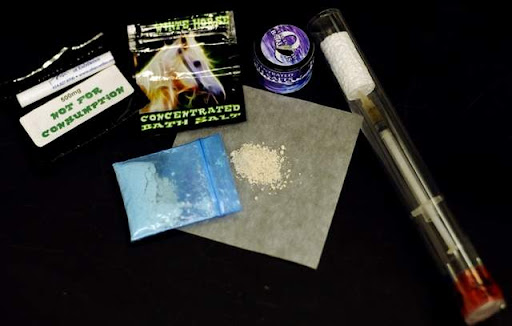 The U.S Drug Enforcement Agency's war on drugs continues with a nationwide ban of synthetic cocaine. Labeled as bath salts, the hallucinogenic drug has become more available in the Grand Junction area as part of a trend seen across the country. In response to increased emergency room visits, the federal agency has moved to emergency control these synthetic stimulants. This action makes it illegal to possess or sell Mephedrone, Methylenedioxypyrovalerone (MDPV), and Methylone or any products containing them for the next year. These chemicals are most often found in forms of 'legal ecstasy' or 'legal cocaine.' During the temporary ban, the DEA will team up with the U.S. Department of Health and Human Services to further study whether these chemicals should be permanently banned. In June, we introduced you to these bath salts in this article. Back then, they were an unregulated drug taking the place of recently banned synthetic forms of marijuana. "It is actually like a synthetic cocaine slash methamphetamine," Jim Schrant with the DEA told us at the time. "So, it's really the worst of both." The bath salts sell at a price of $40 per gram. They are mainly sold at smoke shops. But, in June, Schrant told us that his agency could not find any local dealers. Today, there are at least two. "They're putting it into packaging which is pleasing to the eye with market names of "Blue Dreams," things like that," Schrant said. "And, they're intentionally trying to target that young adult crowd." As part of this emergency control, businesses and citizens have 30 days to get rid of the banned products. At that time, the DEA will publish a Final Order in the Federal Register making the drugs Scheduled 1 substances. That category is the harshest and is reserved for unsafe, highly abused chemicals with no known medical use in the U.S. Violating that law is punishable by jail time. Employees at smoke shops in the area tell us that synthetic cocaine isn't that popular. But, local high school students have heard all about it. "I don't think they care if it's legal," Grand Junction High School freshman Hannah Rady said of some of her classmates. "Nobody does." Just like K2 and Spice, bath salts are labeled "not for human consumption." But, these students say that is not stopping anyone and neither is the law. "People just ask me 'Have you done spice before?' I'm just like, 'No,'" GJHS freshman Emilio Lazcano said. He knows Governor John Hickenlooper made those forms of synthetic marijuana illegal starting July 1, but he says fellow classmates continue to tell bother about it. "They're like 'Oh, well you're supposed to smoke it like this and that,' and I'm like 'Oh, well cool. I'm not really into that stuff.'" "They tell us that it doesn't make their eyes red, so it's way easier to bypass by your parents," GJHS junior Joe Gedscad added. The most common symptoms of these synthetic stimulants include impaired perception, reduced motor control, disorientation, extreme paranoia, and violent episodes. The DEA says the long-term physical and psychological effects are not known but potentially severe. Including Colorado, 33 states have already taken action to control or ban other synthetic stimulants. Most states pass these laws after the DEA files an emergency control on certain chemicals.
Vicente Zambada's lawyers claim he and other cartel leaders were granted immunity by U.S. agents — and carte blanche to smuggle cocaine over the border — in exchange for intelligence about rival cartels engaged in bloody turf wars in Mexico. Controversial defence: Vicente Zambada's claim could throw new light on how U.S. authorities deal with Mexican drug cartels Experts scoff at the claim, which U.S. prosecutors are expected to answer in a filing Friday in federal court. But records filed in support of his proposed defence have offered a peek at the sordid world of Mexico's largest drug syndicate, the Sinaloa cartel, which is run by his father, Ismael Zambada, and Mexico's most wanted man, Joaquin 'El Chapo' Guzman. It's a world of brutality, greed and snitching, and federal agents would love to have the younger Zambada pass along more intelligence, especially if it could help bring down his family's operation or lead to the capture of Guzman, a billionaire who escaped from a Mexican prison in a laundry truck in 2001. Main man: Vicente's father Ismael Zambada, godfather of the Sinaloa cartel, pictured at a party in 1993 'It comes down to whether he would be willing to give up his dad or Guzman,' said David Shirk, who heads the Trans-Border Institute at the University of San Diego. 'Would he be willing to give up his own dad? It seems unlikely.' Zambada, 35, has rarely been seen since his 2009 arrest in Mexico City, after which Mexican authorities paraded him before TV cameras in a stylish black blazer and dark blue jeans. His suave image was a sharp contrast to a photo of him with moustache and cowboy hat released by the U.S. Treasury Department in 2007. He may have upgraded his look after he assumed control over cartel logistics in 2008 and, federal officials say, received authority to order assassinations. Mexico's most wanted man: Joaquin 'El Chapo' Guzman, who escaped from prison in a laundry truck He was arrested and extradited to Chicago a year later to face trafficking conspiracy charges punishable by up to life in prison. The Sinaloa cartel is one of Mexico's most powerful. Named after the Pacific coast state of the same name, it controls trafficking on the border with California and is battling rival cartels in an effort to expand east along the 2,000-mile-long U.S.-Mexico border. Accustomed to luxury in Mexico, Zambada has been held in a 10ft by 6ft cell in Chicago, is often served meals that have gone cold and hasn't been outside in 18 months, his attorneys say. U.S. District Court Judge Ruben Castillo told the government on Thursday to file a response to those complaints. Armed marshals led the shackled Zambada into Thursday's hearing. He appeared at ease, even smiling and winking at a woman sitting on a spectators' bench. Castillo will decide later whether Zambada's provocative immunity claim has any credibility, but many experts said they were skeptical. 'Personally, I think it is a bunch of malarkey,' said Scott Stewart, who analyzes Mexico's cartels for the Texas-based Stratfor global intelligence company. 'I mean, what the defence is saying is that a huge amount of cocaine was allowed to pass into the United States unimpeded. 'Why would you even have sought his extradition if there was this potential backlash?" U.S. prosecutors briefly discounted Zambada's claim in one filing, but more details are expected in Friday's documents. A spokesman for U.S. Atty. Patrick Fitzgerald would not comment on the allegation. Neither would a Washington spokesman for the U.S. Drug Enforcement Agency, whose agents Zambada claims to have dealt with in Mexico. However, clandestine intelligence deals are not uncommon, and conspiracy theories abound in Mexico about the government going easy on one cartel to keep the others under control.'It comes down to whether he would be willing to give up his own dad. It seems unlikely'
Drug Enforcement Cell (DEC) of the Pakistan Customs’ Model Customs Collectorate of Preventive, Karachi airport on Monday recovered and seized 73.5 kilogrammes of fine quality heroin concealed in a huge consignment of herbal medicines. In pursuance of an authentic information passed on by the Additional Collector of Customs, Jinnah International Airport, Manzoor Hussain Memon to the effect that an attempt would be made to smuggle contraband heroin powder out of Pakistan under the garb of medicines in commercial quantity in connivance with Customs officials, a surveillance team under assistant collector, Jinnah International Airport, was constituted for mounting discrete watch over all the outgoing passengers and their baggage. During the course of surveillance, the team intercepted a Pakistani passenger Ghulam Mustafa in the early hours on Aug 21, with his four suitcases when he entered the customs departure hall to take Qatar Airways flight QR-319 for Dhaka via Doha (Qatar). Initial scanning of his baggage indicated the presence of medicine boxes inside all four suitcases. He was, therefore, detained and his baggage was thoroughly examined. Upon examination, the suitcases were found to contain heroin in huge quantity (735 packets) of herbal medicines packets kept beneath a small quantity of mixed allopathic medicines for deceiving the law enforcement staff. As per labels on the packets the herbal medicines were ought to be in paste form. However, when unpacked all the packets were found to contain off-white heroin powder of fine quality instead of herbal medicine pastes. The heroin powder, so recovered, was found to be 73.5 kilogrammes upon weighment. It is worth mentioning here that in the recent years, this is the biggest haul of the heroin recovered from the accompanied baggage of an outgoing passenger at Jinnah International Airport. Another aspect of the case is that the passenger had not only taken a deceptive route to Dhaka via Doha despite availability of daily direct fights to Dhaka from Karachi to hoodwink the customs staff. He entered the departure hall at Sehri time when a number of the law enforcement officers were busy in taking Sehri. Moreover, scrutiny of the passenger’s travel documents reveals that he is in fact a Bengali holding Aliens Registration Card as well as a Computerised National Identity Card that stands expired in 2009. Consequent upon recovery and seizure of contraband narcotics, the accused passenger, as well as two customs officials, who were facilitating in clearance, has been arrested and a prosecution case under Control of Narcotics Substances Act, 1997 has been registered. Third customs official involved in the case is absconding. Efforts are being made to arrest him also. Further investigations are in progress. staff report
Police arrested two Troy men found with drugs Monday evening. An officer stopped a car on 4th Street, just north of Congress Street, around 5:45 p.m., and found the driver, Kevin Peters, 25, did not have a license. The passenger, Shawn Maple, 33, provided a false name. Police say when the officer went back to his patrol car, Peters and Maple took off, but the officer pulled in front of their vehicle to cut it off. When they seized the car, police say they found 45 grams of crack cocaine, 15 grams of heroin, and a large amount of cash. Peters was charged with criminal possession of a controlled substance, aggravated unlicensed operation and unregistered motor vehicle, and improper or unsafe turn. Maple is also facing several charges, including criminal possession of a narcotic with intent to sell, and false personation. Police did not make it known when Peters and Maple will be back in court.
Police are calling a drug-making operation found during a Lakewood fire last week one of the most unusual they've seen in decades. Home video captured the huge fire that leveled a home as explosions rocked the neighborhood. UNCUT: Fire Explodes At Lakewood Home UNCUT: Chopper 7 Over Lakewood Fire At first, police thought they were dealing with a meth lab, when they went inside and found what appeared to be equipment for illegal drug manufacturing. Then, they found bag after bag of scored and burned marijuana and what they say were the makings of a hashish oil factory. "(It's) very unusual," Lakewood police Lieutenant Chris Lawler said. "Even some of the people in our narcotics unit haven't seen this in a long time. ... It's very rare. I haven't seen it in my 20 years in law enforcement." Investigators say the suspect had pounds of marijuana and boxes of butane, and somehow set them on fire while making the oil. Hashish oil is a concentrated form of the active ingredient in marijuana. It's extracted through a process using highly flammable butane. "It's suspected that that was probably the cause," Lawler said. The suspect's father spoke with KIRO 7 on Friday night after his son was taken to Harborview Medical Center with burns over nearly 30 percent of his body. "I don't know what in the world my son was doing," James Rogers said Friday. "I think he was fooling around with some explosives or something he shouldn't have been." The suspect remains in the hospital; it's not clear when he'll be released or what charges he may face.
Drug couriers have started to smuggle hashish into Finland inside their bodies in small swallowable packets.
According to the Customs, the first attempts to bring internally concealed hashish into the country were observed in 2008. In the past several months, however, the phenomenon has become markedly more common. Customs Inspector Tero Virtanen explains that since last December more than a dozen individuals have been stopped and caught on arrival at Helsinki-Vantaa International Airport for trying to smuggle in hashish inside the body. ”Most of them have been men between the ages of 20 and 35. They are professional couriers, and some of them have told the officials that they have made several successful runs to Finland before getting caught. Some of them have also performed deliveries to other Nordic countries.” According to Virtanen, the Customs have confiscated more than ten kilograms of cannabis from the mules. The street value of the lot would have been in the region of EUR 100,000. In addition to this, the officials have learned in the preliminary investigations about the importation of additional roughly 10 kg of hashish. “Thanks to the couriers, several different criminal organisations have now been tracked down in Finland. At the receiving end of the chain there are around a dozen suspects and the spectrum of their nationalities is broad”, Virtanen notes. The Customs believe that hash has been distributed, or was supposed to be distributed, across Southern Finland. The amounts of cannabis that the couriers have swallowed in small packages have varied from half a kilogramme to a kilo. The smugglers doing the ingesting of the small packages have been natives of Spain, Portugal, Morocco, the Czech Republic, and Slovakia. Customs officials suspect that the smuggled substance has generally originated from Morocco and Spain. One of the couriers told the authorities that his fee for the gig was EUR 700. The use of this technique to bring in hashish is a new development: traditionally the internally concealed drugs smuggled into the country have been substances appreciably stronger than hash, such as cocaine and heroin. “Larger hashish consignments are still brought in through other means, but this is a quick way to import narcotics. There will always be a ready market for cannabis”, Virtanen says.
Arrest warrants have been issued for the four residents of a Fernandina Beach, Florida home where former Tennessee and Alabama lineman Aaron Douglas was found dead last month.
The residents, all over 21, allowed at least 16 underage kids to consume alcohol and drugs during the party that claimed Douglas’ life, Fernandina Beach Police stated in a release.
An autopsy of Douglas’ body found that the lineman had multiple drugs in his body, including methadone and Valium, although all details of the event are still surfacing.
Douglas transferred from Tennessee after the 2009 season and signed with Alabama after spending the 2010 season in the JUCO ranks.
former Vancouver cop who pleaded guilty last November to peddling marijuana and breaching his trust as an officer should be put behind bars
Friday, 3 June 2011
former Vancouver cop who pleaded guilty last November to peddling marijuana and breaching his trust as an officer should be put behind bars, a prosecutor told Vancouver Provincial Court Thursday.
Crown prosecutor Joe Bellows told Judge Gregory Rideout during a sentencing hearing that ex-officer Peter Hodson should spend three and a half years in prison for his “well thought-out” drug scheme – which he sometimes operated while on duty. According to Bellows, Hodson intimidated and took advantage of Tyson Pappas – a self-confessed drug addict living in the Downtown Eastside – by convincing him to help sell pot on the streets.
“He was in the business of trafficking for profit . . . and he was in it for the long haul,” Bellows said.
Hodson was arrested in April 2010 after an in-depth investigation by both RCMP and VPD officer, including the set-up of 10 drug-money transactions with the help of Pappas.
During the final transaction on April 15, 2010, Hodson met with an undercover cop, who he thought was a potential client, and agreed to sell the cop a half-pound of pot every Friday for $1,500. “As long as you need it, I can get it to you,” Hodson was reported saying.
By the time he was arrested on April 21, Hodson had peddled about 28 ounces of marijuana, with a street value of $7,900, Bellows said. He was 31 years old at the time and had been working as an officer for less than five years.
In a statement issued the day he was arrested and fired, Chief Constable Jim Chu called Hodson a “rogue” officer who breached his trust as an officer.
On Thursday afternoon, a stony-faced Hodson listened as the Crown spoke about his extra-marital affairs, his “narcissistic tendencies” and how he showed little remorse for his behaviour when he was arrested.
Judge Gregory Rideout said he was concerned about Hodson’s abuse of his position as an officer. He also expressed worry that Hodson put colleaues and the community at risk by bringing drugs into a vulnerable area of the city.
Hodson’s lawyer, Vincent Michaels, said he is looking for a conditional sentence – to serve in the community rather than in custory.
“We want to bring this to a conclusion as soon as possible,” Michaels said outside the courthouse, calling the last year a “traumatic time” for Hodson.
73-year-old man who tried to smuggle £100,000 worth of heroin into the UK through Heathrow Airport has been jailed for five years.
Saturday, 7 May 2011
David Pryor, of Priory Road, Wellingborough, was arrested by UK Border Agency officers on September 5 last year after he arrived at Terminal 5 on a flight from Tanzania.
Following a search, about 4kg of the drug was found concealed in baskets which he was carrying in his dark green suitcase.
Officers examined the three unusually-heavy woven baskets and found heroin concealed within the weave. In total, the drugs had an estimated street value of about £100,000.
Pryor was jailed at Isleworth Crown Court yesterday after he had pleaded guilty to a charge of attempting to import a Class A drug at an earlier hearing.
He was also banned from travelling anywhere outside the UK for two years after the completion of his sentence.
When he was first questioned, Pryor claimed he worked for a law firm and had been to the Tanzanian capital Dar Es Salaam to take a witness statement.
Before entering his later guilty plea, he had claimed that the baskets had been given to him as a gift by the cousin of the witness he had been to visit and that he had no idea the heroin had been hidden inside.
Commenting on Pryor’s age, assistant director Peter Avery of the UK Border Agency’s Criminal and Financial Investigations unit said: “There is simply no such thing as a typical drugs smuggler.
“Anyone, whatever their age or background, can be tempted to participate in this awful trade.”
If you're a parent of a teenager, this next story could be one of the most important you'll ever see. Heroin deaths are exploding across our area, and it's no longer affecting just people on skid row.
It's in suburbs including West St. Louis County, and even in high schools. Its purity is as high as 90 percent, and police say it's easier to get than marijuana.
This is a look at how heroin has destroyed lives and how you can spot an addict.
"I was addicted to meth, I was addicted to cocaine," said Heather Helton of Jefferson County. "Heroin was the one thing that was so hard for me to get away from, so hard."
"Hard" describes 22 year-old Heather life. She's been doing drugs since 12 and first started using heroin at 17 to please a boyfriend.
"I wanted to make him happy and I thought that would be one way to make him happy," she said.
Once a cheerful and friendly pom-pom squad student, on heroin she dropped out of high school, turned manipulative, defiant.
"It's all about the attitude. I went from being bubbly, outgoing, confident, to being angry," said Heather. "I fought a lot more, about little petty things, I was much more secretive."
She eventually stole from her own family, and started stripping, even begging, to pay for her habit.
"I didn't call for days, weeks at a time, and that's because I was high," said Heather. "There's things I've done that people just shouldn't do at all."
At the time of this interview, Heather says she'd been clean for 31 days, and had just checked herself out of a 13 month residential treatment program after just one month.
She says red flags your child or someone close to you might be using heroin include changes in attitude, and manipulative behavior.
"Once I realized how well I can manipulate my own family, it went outward," she said. "I manipulated men beyond belief at an age when men shouldn't be on your mind."
Changes in clothing and grooming habits can also be a sign of heroin abuse.
"If they're hiding their arms from you, or they used to wear flip-flops and they're not wearing flip-flops, and they wearing pants all through the summer, you probably have a problem," Helton said. "You should probably sit down and ask about it."
Mirroring the heroin crisis are heroin deaths that have doubled-even tripled-in some counties. Valerie Butler, Jessica Eberhardt, and 17-year-old Shannon Gaddis are just a few of the dozens of heroin fatalities so far this year. Twenty-eight people have died in St. Louis County thus far in 2011, up from 13 at this same time last year.
"It can happen to anyone," said Pam Jones, a St. Charles mother of two. "If it can happen to Andrew it can happen to anyone."
May 12 will mark the one year anniversary of her son's death from a heroin overdose.
"He came home and said goodnight and used and died," said Terry Jones, Andrew's father.
It happened in a bathroom in the home he lived in with his parents. His fatal overdose was even more shocking because Andrew was supposed to be sober and in treatment at the time.
What started as prescription drug abuse as a college sophomore led him to try heroin the summer before his junior year.
"He sweat a lot, slept a lot, just withdrawn," said Pam. "Just very agitated, long sleeves, stayed in the basement a lot."
Hopelessly addicted, Andrew Jones dropped out of college during the first semester of his junior year and returned home.
"The friends change, the attitudes change, when it got full blown there was the stealing, looking for any way to get that," said Terry. "It's cheap, 10 dollars a pill, and high grade."
They took away his keys, cell phone, access to money. The Jones' resorted to doing things they never thought possible.
"When he OD'd and they dropped him off in the street, I went after the drug dealer," said Terry.
"This is probably the biggest epidemic St. Louis has ever seen," said Pam. "Why didn't we know about this? Why weren't they talking about it?"
Here's how to recognize a user: along with changes in attitude and friends, look for unexplained sweating, sleeping at odd hours, irritability, manipulation, lying, valuables or spoons missing from your home, and black marks on counter tops.
Forty-eight hours after checking out of rehab, Heather wanted to talk publicly about her addiction, hoping to save just one life. Wishing that life could have been her brother, Cody, defiant and dead from a heroin overdose at just 17 in January 2009.
"He said he was going to die getting high, and nobody could change it, and he did," Helton said.
"Everybody asks me how can you find your brother dead and go out and still use? How couldn't you? I have a substance right here in the palm of my hand that allows me not to feel anything and that's what I want at this point in time."
Helton said she wants to go back to rehab. If she does, she faces daunting odds. The success rate of treating heroin addiction is only about five percent.
A batch of extra-strength heroin is on a deadly rampage in B.C.'s Lower Mainland, the B.C. Coroners Service warned Thursday.
"Heroin being dealt to users in some areas is at least twice as potent as usual," the coroners service advised, citing 20 heroin overdose deaths so far in 2011, double the number of deaths last year.
Drug users should "never be alone when ingesting drugs, and where possible (should) use available community services such as INSITE or needle exchanges," the coroners service warned.
At Insite, B.C.'s only supervised-injection site, the waiting room was full Thursday of anxious drug-users waiting for a cubicle to safely inject drugs.
Insite registered nurse Tim Gauthier, one of two on-duty nurses who save on average the lives of 18 to 23 overdosing users a month, confirms "we have had 36 overdoses just from April 5 to May 5 this year."
None of the 3,000-plus people who have overdosed at Insite has ever died.
Victor, 41, an intravenous-drug user since 1997, said he's "heard people say there's strong heroin being sold that just makes people drop.
"That's why I would never, ever shoot up alone — you shoot up in an alley or in your room and by the time you can say 'Uh-oh' it's too late.
"Here if you OD, and I've done it twice, they're going to bring you back."
Mark Townsend of the Portland Hotel Society, which runs Insite, said "the Vancouver police haven't warned us about especially potent heroin and they're usually pretty good about that.
"Medicine and science statistics prove Insite saves lives and the B.C. government is onside but we still have to argue that in court next week."
Townsend, and Gauthier for the B.C. Nurses' Union as interveners, go to Ottawa next Wednesday to hear the federal government's appeal of two B.C. Court rulings that have allowed Insite to stay open.
Insite backers have won two B.C. court rulings based on Charter rights and provincial jurisdiction over the safe-injection site which opened in 2003 but the feds appear determined to close Insite, despite backing by police and coroners.
Vancouver Police Const. Lindsey Houghton said "we don't attend all ODs unless they are deemed suspicious," and added he had "no information available. We don't test the heroin ourselves."
After two recent OD deaths, Kelowna RCMP and the Coroners Service have done tests confirming the presence of super-potent heroin but don't yet know its source.
The deaths have occurred throughout the Lower Mainland, including Burnaby, Surrey, Abbotsford and Chilliwack, said regional coroner Vince Stancato.
five month-long investigation into a drug distribution network resulted in drug and weapons charges this week for several Jersey Shore residents
Sunday, 27 March 2011
five month-long investigation into a drug distribution network resulted in drug and weapons charges this week for several Jersey Shore residents, including a Brick man who faces charges of leading the operation, Ocean County Prosecutor Marlene Lynch Ford announced Thursday.
As a result of the raids, authorities confiscated approximately 800 grams of cocaine, a 9mm handgun, a 25-caliber handgun, a Mac-10 submachine gun and approximately $50,000 in cash. The investigation included FBI and law enforcement agencies in New Jersey, Pennsylvania and Maryland. Suspects from Brick, Toms River, Point Pleasant Borough, Point Pleasant Beach, Manchester and Lakewood were arrested.
In large part, South Florida sees the pain pill epidemic from the supply end – the long lines at the pain clinics, the occasional raids with doctors hauled away in handcuffs., the political battles over whether and how to regulate so-called pill mills.
Shawn Clusky is at the other end of the oxy pipeline: Kentucky.
Clusky first tried OxyContin at age 17 with his school buddies, shortly after the high-powered narcotic painkiller went on the market. He went from occasional user and seller until about age 21, when he became fully addicted.
When he was 25, he got busted at a Lexington gas station for selling $15,000 worth of pills. Clusky received probation, but was still using until he was sent to the WestCare rehabilitation center in eastern Kentucky.
He now works there as a counselor. And is lucky to be alive.
“We’ve got more people dying of prescription drug overdoses than car accidents,’’ said U.S. Rep Hal Rogers.
Indeed, as far back as 2002, early in the epidemic, one fourth of all OxyContin-related deaths in the country took place in eastern Kentucky.
The problem is now so entrenched that the cheap flights and van rentals drug traffickers use to travel from Florida, with its lax laws on pill distribution, to Kentucky and other states to peddle “hillbilly heroin’’ are nicknamed the “OxyContin Express.’’
Some here in Kentucky harbor a deep resentment at Florida’s unwillingness to crack down on pill sales, for instance, at its refusal to set up a prescription database similar to those in other states to ensure that customers are not “doctor shopping’’ – scooping up some pills here, more pills there – by dealing with multiple physicians.
“Crook doctors operating these pill mills’’ in Florida are running rampant and are fueling the flow of illegally obtained prescription drugs to states such as Kentucky, Rogers, the chairman of the House Appropriations Committee, told Attorney General Eric Holder during a recent hearing. “My people are dying.’’
MOVING TARGET
According to a study by the Substance Abuse and Mental Health Services Administration, there was a fourfold increase nationally in treatment admissions for prescription pain pill abuse during the past decade. The increase spans every age, gender, race, ethnicity, education, employment level and region.
Nearly every family in eastern Kentucky has been touched by prescription-drug addiction and death.
In the late 1990s, it was easier to find OxyContin — pure oxycodone with a time release — in Kentucky. The pill’s maker, Purdue Pharma, was selling it “hand over fist’’ to doctors in eastern Kentucky, rich with coal mine injuries and government healthcare cards, Clusky said.
Clusky said a high school friend who worked at a pharmacy would steal the pills for his friends, so “It didn’t cost any of us anything.’’
When many of the eastern Kentucky pill sources dried up after law enforcement raids in 2001, Clusky said, the trade moved to Mexico, where oxycodone could be bought for pennies over the counter and sold for as much as $100 a pill in the rural United Stages Clusky began making trips to Nuevo Laredo, driving back home with thousands of pills. By this time, heroin was his drug of choice. He often traveled to larger cities, where heroin could be found more cheaply.
The Border Security Force (BSF) Sunday recovered two kg of heroin and Rs.500,000 in counterfeit currency from near the international border in this Punjab town
The Border Security Force (BSF) Sunday recovered two kg of heroin and Rs.500,000 in counterfeit currency from near the international border in this Punjab town, an officer said.
'During our regular patrolling, we have recovered heroin and fake currency from near the Bishambhar BOP (border outpost). So far no arrest has been made in this case,' Pankaj, BSF's deputy inspector general (Punjab frontier), told IANS.
BSF troopers guard the 553-km international border in Punjab.
Fazilka town falls in Punjab's Ferozepur district, around 250 km from state
Andre Picard of Riceville, New Brunswick, was sentenced Friday in U.S. District Court in Bangor.
Tuesday, 22 March 2011
Picard pleaded guilty last August to smuggling marijuana across the border between 2005 and 2007. Prosecutors say Picard and his network of drug runners delivered 100 to 135 pounds of pot each week to distributors in Maine, Vermont, Massachusetts, Connecticut, New York, New Jersey and North Carolina.
At least five other people involved in the scheme have been charged or sentenced.
According to the Bangor Daily News, Picard's attorney said his client became involved in the scheme because he was addicted to money and greed.
Officials say inmates at a Pennsylvania prison received drugs from the outside hidden beneath the postage stamps on their mail
Officials say inmates at a Pennsylvania prison received drugs from the outside hidden beneath the postage stamps on their mail.
Five inmates and six of their loved ones face charges in a sting dubbed "Operation Postage Stamp." Prosecutors said Monday the inmates' family and friends used stamps to cover up doses of a prescription drug available in the form of a thin film meant to be dissolved under the tongue.
Prosecutors say the doses of Suboxone would be concealed under the stamps of letters and mailed to inmates at the Carbon County Correctional Facility.
Suboxone is a prescription narcotic used to treat heroin addiction.


Popular Posts
-
 Red Scorpion Gang Leaders are Jonathan, Jarrod and Jamie Bacon These 3 brothers are believed to be in the top ranks of a drug-trafficking gr...
 -
 "We're just here to support our guys," Charles "Pee Wee" Goldsmith, a Hells Angel from Nevada, said last week. Many ...
 -
The Sons of Silence, one of the country’s biggest outlaw biker gangs. With its headquarters in Colorado, the Sons of Silence (SOS) are known...
-
 Aryan Brotherhood in other names AB,Brand,Tip,Alice,Alice Barker were formed in California's San Quentin State Prison.The Aryan Brotherh...
 -
 Timothy “Fuzzy” Timms, a 45-year-old member of the Hells Angels Motorcycle club, stood up Monday for his First Amendment right to freedom o...
 -
Glaswegian was killed as rival gangs armed with blades, including a Samurai sword, clashed in a terrifying street fight.Police were last nig...
-
 Jerry Turcotte, 48, was arrested by Peru's federal police in May and escaped from a jail cell in Lima on Sept. 22 after overpowering a j...
 -
Gov. Mike Beebe announced Friday his intention to grant pardons to nine Arkansans, including a man who claimed to have founded Little Rock’s...
-
The chronology of cannabis -------------------------------------------------------------------------------- 2737 BC: Cannabis referred to as...
-
 motorcycle gang Hells Angels, have made the Dominican Atlantic resort town Cabarete their home in the Caribbean. “They're impossible to ...
-
-
Gang boss burns out garda sergeant's car while he plays football - Gardai have launched a major investigation after a car belonging to a popular sergeant was burnt-out in a grudge attack linked to gangland thugs. SHARE T...
-
Lionel Messi to be prosecuted for alleged tax evasion - A Spanish court will push ahead with prosecuting the Barcelona forward Lionel Messi for alleged tax evasion despite a recommendation from the public pros...
-
Spanish police have arrested a Colombian drug boss dubbed ‘The Mouse’, the alleged leader of a major cocaine smuggling gang accused of 400 killings - Spanish police have arrested a Colombian drug boss dubbed ‘The Mouse’, the alleged leader of a major cocaine smuggling gang accused of 400 killings, offi...


